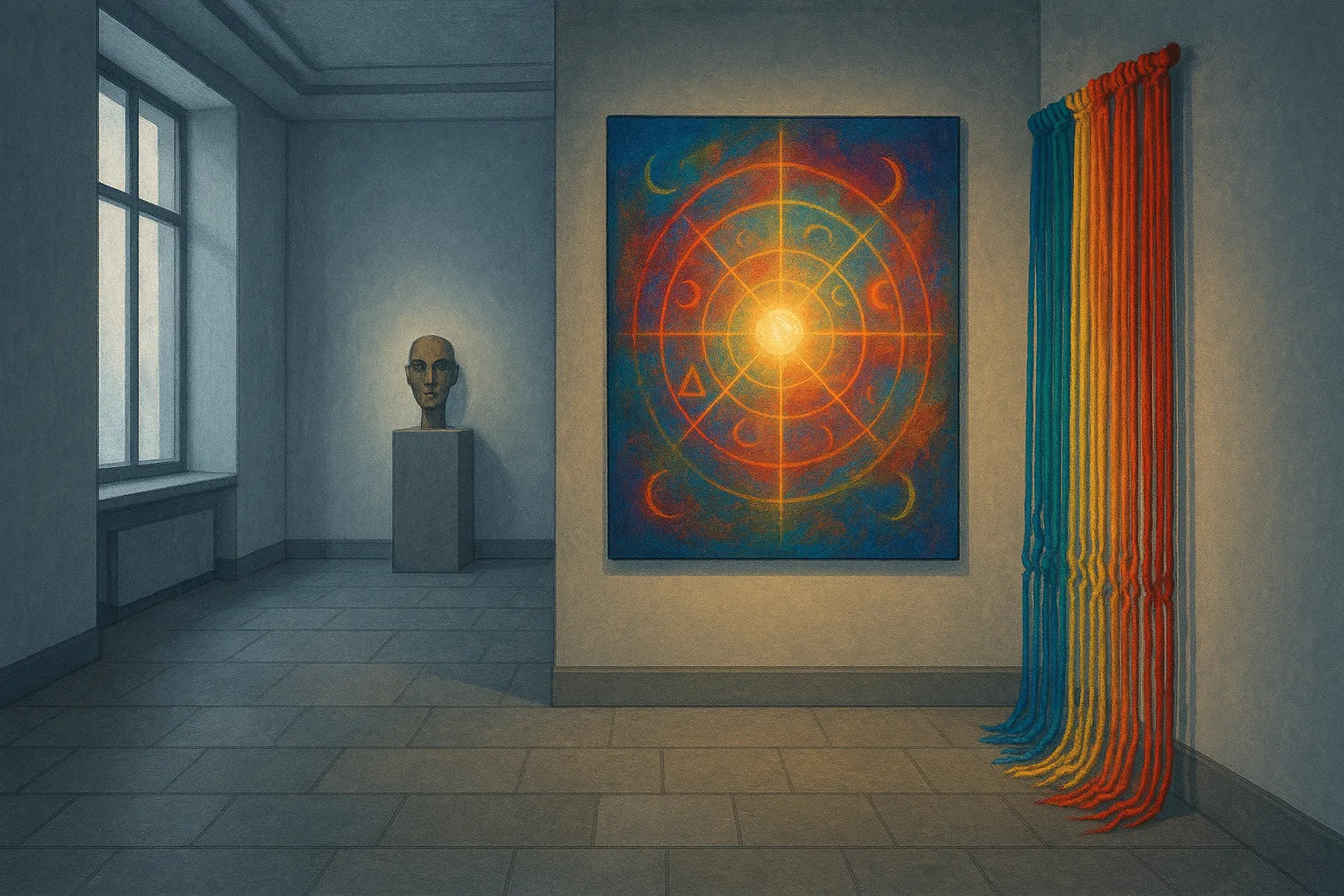
The Finnish National Gallery turns a sharp lens on spirituality and artistic kinship with Arcana Borealis—Northern Women and Esotericism, opening soon at the Atenium Art Museum in Helsinki. Bringing together more than 200 works by 50 artists, the exhibition focuses on how belief systems, ecology, and imagination have shaped modern and contemporary practices. Curators Dr. Nina Kokkinen and Dr. Marja Lahelma frame the presentation as a corrective to “art historical narratives that have privileged the myth of the lone artistic genius,” the museum says.
Spiritual channels and early abstraction
Around 1906, Hilma af Klint was living in Stockholm, keeping a studio and delving deeply into Christian esotericism. She translated mystic visions into otherworldly paintings that art historians acknowledge as the first known abstract works in the canon, a paradigm shift previously credited to Wassily Kandinsky starting around 1910. Her approach treated painting as a vehicle for spiritual channeling rather than a purely aesthetic pursuit. The period overlapped with major scientific advances: Nikola Tesla had developed the alternating current (AC) electricity system, generated the first radio transmissions, and used them to create a remote control, while 1905 was Einstein’s “miracle year” with the publication of his seminal theory of relativity.
Arcana Borealis places af Klint alongside peers and successors including Anna Cassel, Anna-Eva Bergman, Maja Fjaestad, Sonja Ferlov Mancoba, and contemporary artist Outi Pieski. Media range from painting and sculpture to textiles, stained glass, and video, underscoring how spiritual inquiry has coursed through many materials and methods.
Networks, performance, and the North
The exhibition emphasizes community as a catalyst. Cassel and af Klint collaborated within The Five, a Stockholm-based circle of women who pursued séances and meditation to explore spiritual realms. Collaboration also drives Pieski’s performance “Guhte gullá / Here to Hear,” created with dancers and choreographers Biret and Gáddjá Haarla Pieski. Drawing on their Sámi heritage and incorporating vibrant clothing that nods to traditional garments, the work addresses trauma inflicted by state-sponsored assimilation programs and discrimination going back centuries.
The title joins Latin arcana (“hidden knowledge”) and borealis (“the north”). The show “approaches ‘the North’ as a cross-border cultural and imaginative space shaped by mythology and spiritual traditions,” the museum says. “It traces how artists across Finland, Sweden, Denmark, Norway, Iceland, and Sápmi turned to esotericism, alternative cosmologies, meditation and mediumistic practices to explore questions of existence, creativity, and belonging.”
Arcana Borealis opens on October 23 and continues through February 28, 2027, in Helsinki.