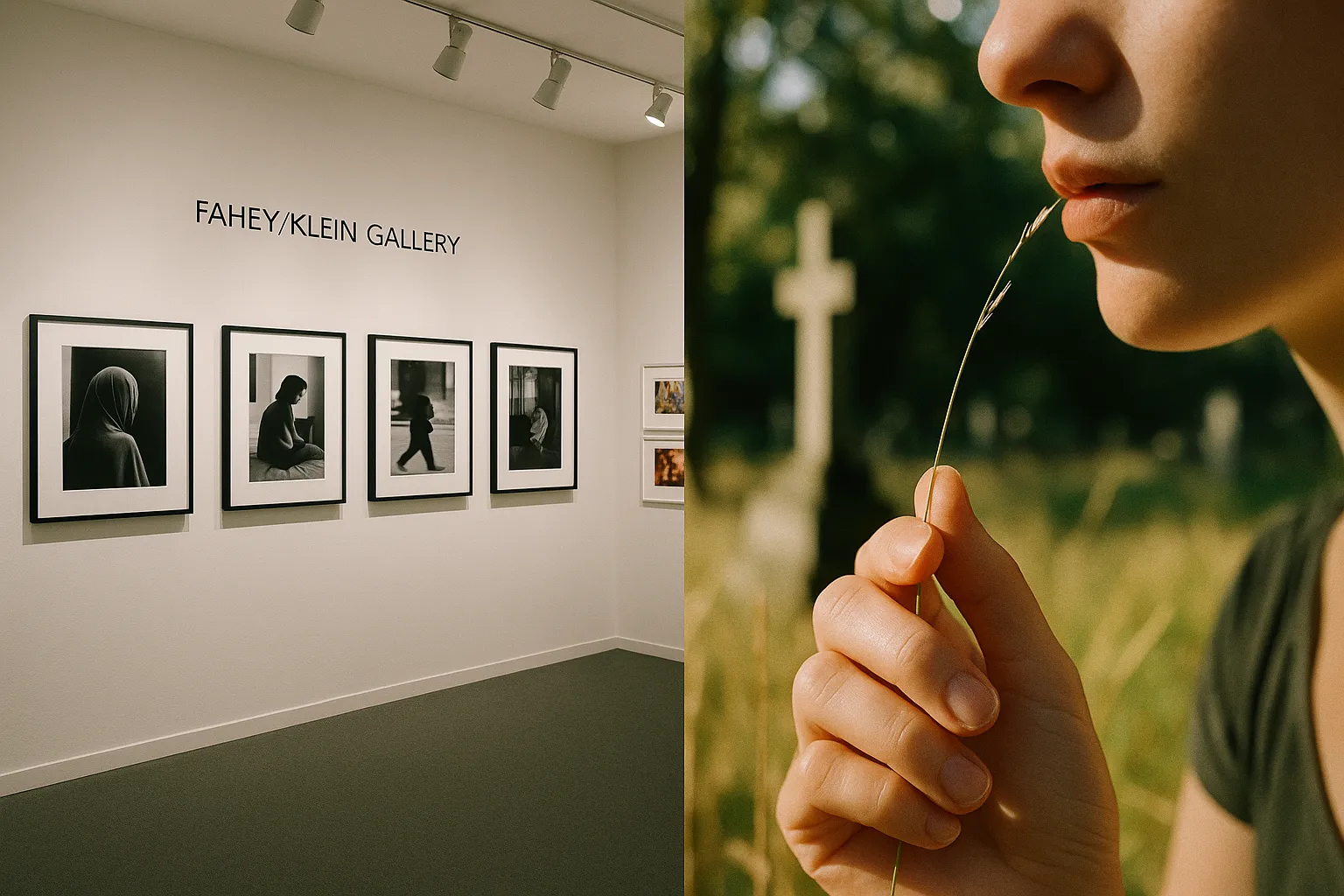
Timed to the Taschen publication “My Education,” the first book-form retrospective of Bruce Weber’s multi-decade career, Bruce Weber: Try a Little Tenderness fills Fahey Klein Gallery with a crowd-pleasing yet introspective survey. The opening line ran down the block, with the famed photographer in attendance, and the packed room made it hard to linger with the 60+ framed images. A return visit reveals a show that rewards slow looking, organized around the fragile, resonant theme in its title.
Touch, memory, and the long gaze
Weber’s gorgeously printed black-and-white photographs anchor the exhibition, while a tight suite of seven color images argues for the sensuous pull of film—the saturated hues conjuring summers past. Across fathers and children, siblings, friends, possible lovers, and even people and animals, gestures of embrace and the charged space between sitters recur again and again. Though Weber does not identify as a “queer photographer,” the exhibition underscores why many see his work as pivotal in bringing queer iconography into the mainstream.
Two portraits sharpen the show’s thesis. In Sir Ian McKellen and Peter Johnson, Old Brompton Cemetery, London, England, 1999, McKellen, in a dark suit and tie, holds a blade of grass to Johnson’s lips as the younger man reclines, eyes closed. The image suggests both classicism and spontaneity, echoing art-historical touchstones like Narcissus by Gyula Benczúr (1880) and Michelangelo’s The Creation of Adam (1508–1512), while the cemetery setting brushes the scene with mortality. Nearby, a close-up of Nina Simone—staring directly into the lens while embracing a young man whose face is obscured—reads as a tender yet unflinching pietà. The portrait acknowledges a lifetime of hardship and sacrifice; Simone self-identified as bisexual and experienced bipolar disorder in her later years, and the text notes how racism, sexism, and her refusal to tolerate either shaped her career.
Elsewhere, the range is broad: Edu and Jorge, Porto Ercole, Italy, 2022; Kate Moss and friends, Miami, Florida, 2003; Uncle Lionel Batiste and Dr. John with members of the Treme Band, New Orleans, Louisiana, 2008; and On Leave in Waikiki, 1982. Many subjects are gone—Allen Ginsberg, Christopher Isherwood, Elizabeth Taylor, Nelson Mandela, Jeff Buckley, River Phoenix—yet in the gallery’s quiet hours a Chet Baker soundtrack threads through, a fitting nod to Weber’s acclaimed documentary Let’s Get Lost.
The exhibition does not ignore turbulence. In 2017–18, Weber faced accusations of inappropriate behavior toward some models; cases were dismissed or settled out of court, and the scandals affected his career. Here, a meaningfully curated selection advances a simple premise: tenderness is worth seeking and celebrating. Bruce Weber: Try a Little Tenderness is on view at Fahey Klein Gallery, 148 N. La Brea Avenue, Los Angeles, CA 90036, from April 9–June 6, 2026.
Vía artandcakela.com