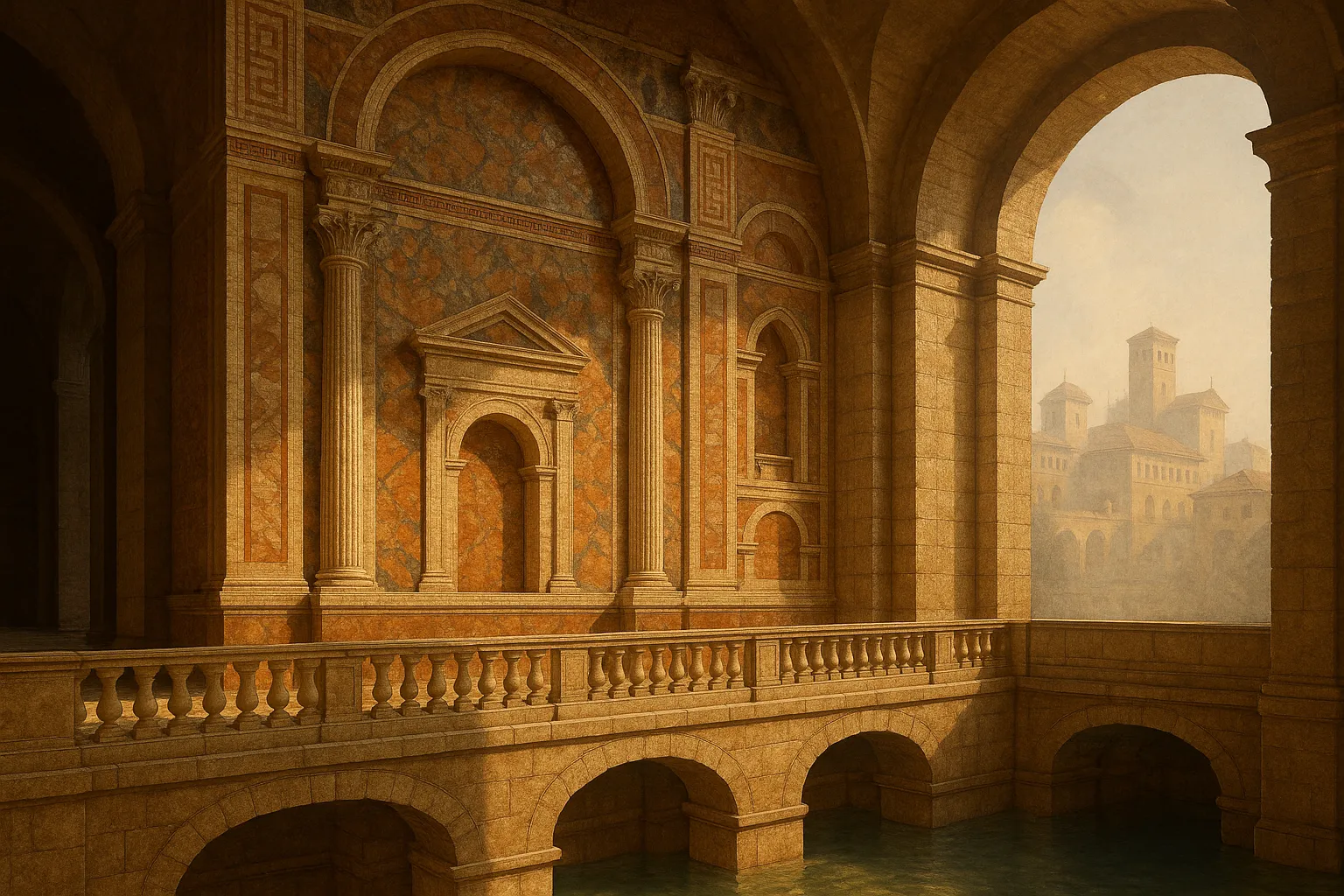
A vast ancient mosaic, newly accessible to visitors in central Rome, may be the largest in the entire Roman world. Measuring 33 feet wide and 52.5 feet high, the in situ work—dubbed the “Great Mosaic”—is a centerpiece of the recently opened Museum of the Baths of Trajan. The museum preserves a monumental, early 2nd-century bath complex built by Emperor Trajan that spans about 15 acres on the Oppian Hill.
Constructed on ground once occupied by Emperor Nero’s Domus Aurea, or “Golden House,” originally erected between 64 and 68 C.E., the baths reused elements of that earlier palace. It remains unclear whether the mosaic itself originated in the Domus Aurea; archaeologists suggest it could also have belonged to a lavish dwelling later absorbed into the compound. Many tesserae from the monumental composition are missing and may have been repurposed during the baths’ construction.
The ‘Great Mosaic’ and a Newly Visible Fresco
Discovered in 2011, the “Great Mosaic” has been meticulously revealed and conserved over the years. Its architectural imagery may evoke a dual-level theatrical set, known as a scaenae frons, and it features statues of the Muses alongside other figures and patterns that imitate veined marble. Excavation continues, particularly in a section that focuses on wine-making and grapes, while much of the mosaic can now be viewed from an elevated walkway.
Within the same complex, an architectural fresco unearthed in the 1990s also goes on public view for the first time. Known as the “Painted City,” the scene appears as a sweeping aerial perspective of a port city—though it is uncertain whether it portrays a real locale or an imaginary one. According to CNN, the vista includes unusual details such as public squares and towers that were not common features of municipal design in the 1st century.
Together, the “Great Mosaic” and the “Painted City” open a rare window onto the ambitions of Roman architectural decoration and urban imagination, now legible within the very fabric of the Baths of Trajan.