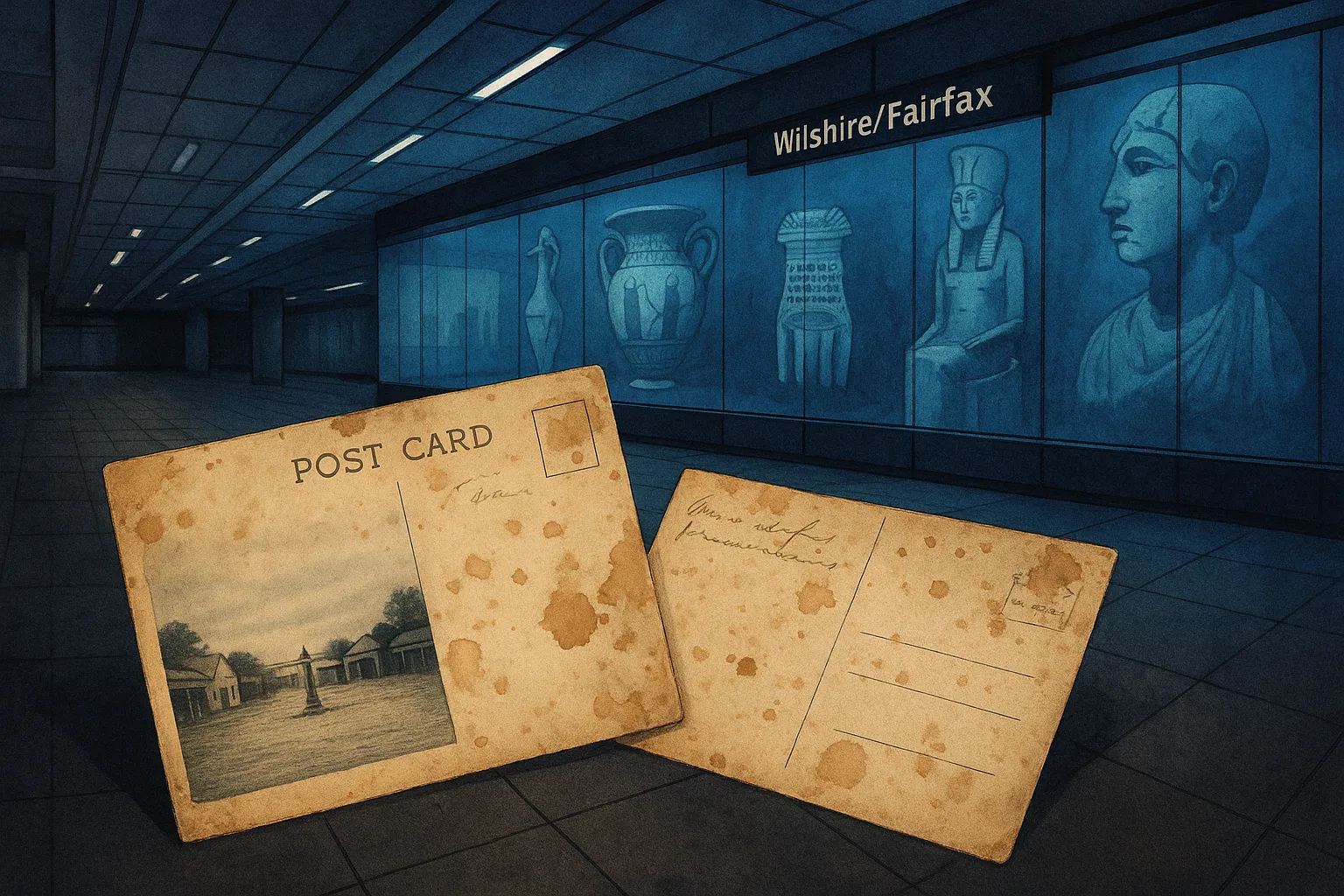
Silver Lake-based photographer and artist Ken Gonzales-Day moves between the subway and the historical record with uncommon precision. At the recently opened Wilshire/Fairfax station on the Metro D Line, the Concourse Level hosts his installation Urban Excavation: Ancestors, Avatars, Bodhisattvas, Buddhas, Casts, Copies, Deities, Figures, Funerary Objects, Gods, Guardians, Mermaids, Metaphors, Mothers, Possessions, Sages, Spirits, Symbols and Other Objects, inspired by glass murals featuring photographic enlargements of more than 70 objects from LACMA’s diverse collections. From there, his practice leads to far darker ground.
Erasing the spectacle
In his book Lynching in the West 1850–1935, Gonzales-Day shifts attention from Dixie to the American West, noting 354 cases of lynchings in California alone, with victims who were Latinx, First Nations, and Asian Americans. “Part pilgrimage and part memorial, my work has taken me to hundreds of California’s lynch sites, and no matter how pristine or developed these sites may be, my experience of the landscape has been forever transformed,” he writes. He began by photographing lynching sites where few records remain, then digitally removed victims from historic photographs for his 2006 Erased Lynching series to avoid “re-victimizing” them.
“The images are all photographic but were not made in an analog or ‘wet’ darkroom… The images have all been digitally processed in Adobe Photoshop or other image-editing software,” Gonzales-Day notes. “I used Photoshop to remove the victim and the rope from each image (when present)… The final digital images were then printed and mounted on heavy card stock to replicate the materiality of historic postcards and view cards to foreground the commodification of their distribution, often via the U.S. Postal system.” Works in this vein include Lynching of Leo Frank, Atlanta, GA., 1915, Erased Lynching Series # 2, 2016 (h 4in x w 6.25in), and East First Street #1 (Lynching of Thomas Thurmond & John Holmes, San Jose, CA. 1933), Erased Lynching Series # 1, 2006 (6 x 3.6 in). “I would say that many of these killings were racially motivated,” he adds, linking them to “false ideas around human difference,” the displacement of Indigenous peoples, settler colonialism, and the history of slavery.
The crowd in the frame
The NAACP documents 4,743 known lynchings in America between 1882 and 1968, centered in the South and the murders of Black children, women, and men. Spectacle was part of the machinery: municipalities hired photographers; “lynching picnics” produced souvenir postcards; spectators collected remnants from the scene. A 1915 postcard from Temple, Texas, sent by Joe Meyers and depicting the lynching and burning of William Stanley, read, “This is the Barbecue we had last night.” In Cairo, IL, the 1909 lynching of William James reportedly drew more than 10,000 spectators, with the victim all but invisible in the surviving crowd image. Gonzales-Day’s erasures, by contrast, redirect attention: “to conceptually redirect the viewer’s attention away from the terrorizing spectacle of lynching and death and to make tangible the complex histories of settler colonialism, systemic racism, the legacies of slavery and Jim Crow laws, anti-Semitism, and whiteness.”
Seven decades after the 1955 lynching of fourteen-year-old Emmett Till, President Joe Biden signed the Emmett Till Anti-Lynching Act on March 29, 2022, classifying lynching as a federal hate crime. Gonzales-Day’s work keeps the record in view—and asks who is looking, and why.
Vía artandcakela.com