An elongated, white volume—somewhere between an igloo and a giant snail—has appeared with a curious proposition: step inside a camera. Premiered late last month at MODE Festival, a celebration of global photography, Pneuhaus’ latest work, the immersive “Compound Camera No.3,” transforms a large-scale architectural inflatable into a luminous viewing room equipped with 221 lenses.
Inside a solar-lit, analog projection
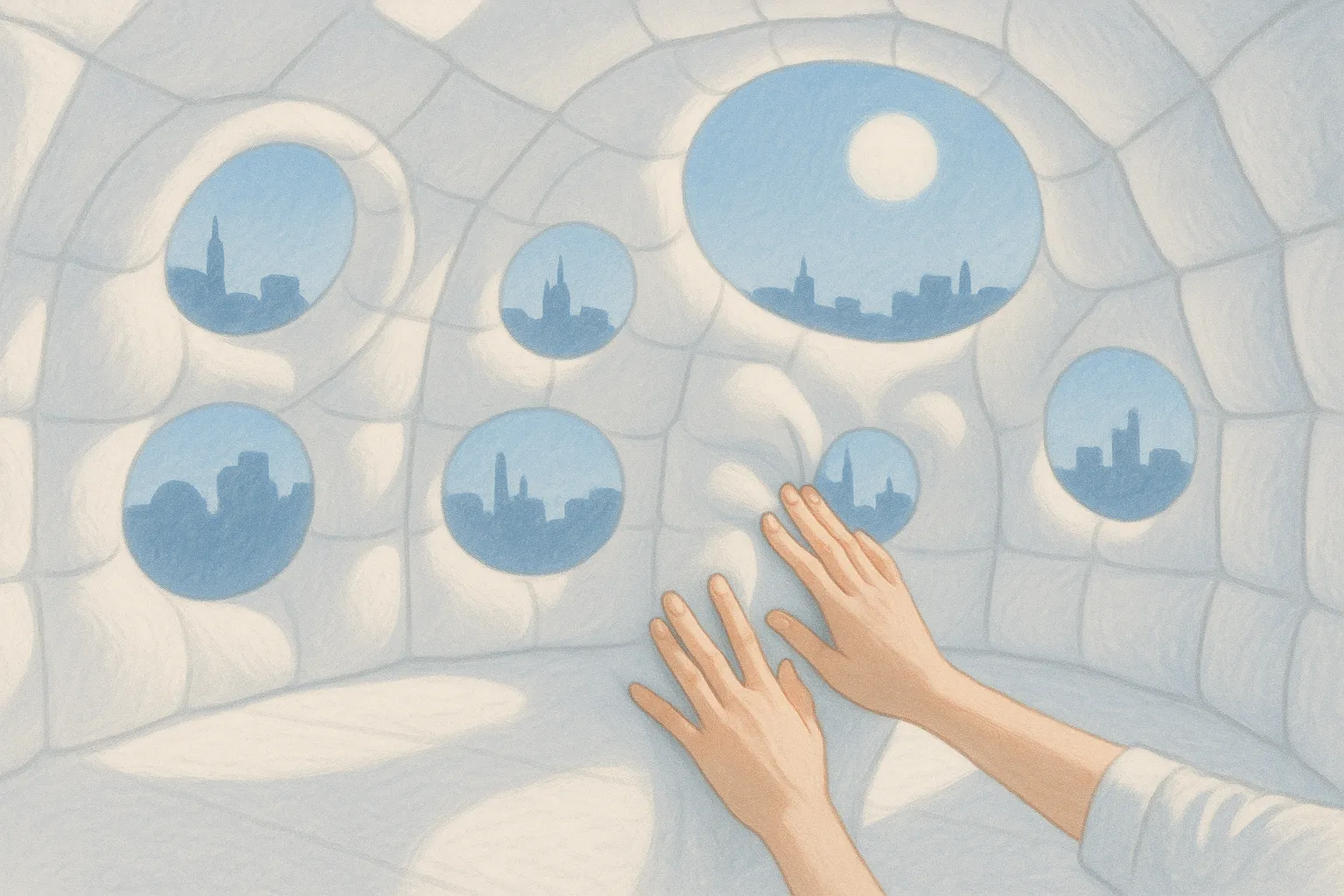
Based in Rhode Island and known for large-scale, architectural inflatables, Pneuhaus scales up the camera obscura into an environment covering more than 700 square feet. Visitors wander within a projection powered entirely by the sun, as images enter through tiny apertures and settle onto soft, bulbous interior surfaces. With no LED screens in sight, everyday scenes are rendered by an essential analog method: sunlight alone.
The installation rewards slow looking. Lenses aimed upward cast the sky across dozens of interior facets, recalling the structure of an insect’s eye. Those pointing sideways map nearby trees, buildings, and passersby. As the imagery multiplies across the textured interior, visitors can gently push on the pliant surface to warp what Pneuhaus describes as a “bug’s-eye view” of the sky and urban surroundings, nudging the picture in real time without leaving a trace.
Presence, not surveillance
In an era saturated with cameras—from license plate readers to doorbell devices tied to vast private data networks—“Compound Camera No.3” inevitably brushes up against conversations about surveillance. Here, though, the premise shifts: the “information” is about being present. Nothing is recorded. The work repositions image-making as a shared, momentary experience, inviting people to examine details more closely than they might outside the inflatable’s shell.
As a giant, walk-in camera and an immersive pop-up room with a futuristic, bubble-like texture, Pneuhaus’ installation connects the oldest principles of optics with contemporary public space. By multiplying familiar vistas into a kaleidoscope of skylines and silhouettes, it reframes perception without collecting data—an expansive, tactile camera obscura that lives only in the light of the moment.