“Every moment is an organizing opportunity, every person a potential activist, every minute a chance to change the world,” said Dolores Huerta. That spirit animates Rebels with La Causa: Royal Chicano Air Force Art and Activism, 1970–1990 at the Crocker Art Museum in Sacramento, on view February 22–June 28, 2026.
Founded in Sacramento in the early 1970s as the Rebel Chicano Art Front, the Royal Chicano Air Force (RCAF) brought together printmakers and muralists with writers, musicians, performers, and teachers to forge a multimedia cultural hub for social change during the era of Civil Rights movements. Much like Self-Help Graphics in Los Angeles, the collective established an enduring Day of the Dead celebration with altars, parades, and copious artworks, and organized community concerts, conferences, festivals, and athletic events—creating a trove of posters, many of which are now on view at the Crocker.
Icons of identity in print
Among the posters, Max Garcia’s Pilots of Aztlan—Royal Chicano Air Force (1995) is a screen print featuring three long-haired figures in a triangular arrangement. One figure at left wears Aztec jewelry and pilot’s goggles; at right, a figure in a ribboned military uniform sports a hat emblazoned with “RCAF”; above, a headbanded figure is crowned by an arc of desert plants. The words “Pilots of Aztlan” sweep over a map of Mexico and Central America. The work, like many RCAF posters, underscores Chicano identity and the fusion of indigenous and Euro-American heritage.
Juanishi Orosco’s Fiesta de Colores (1979), also a screen print, centers a hovering Tlaloc, the Rain God, pouring drops from outstretched hands over a tall pyramid. In place of a temple atop the truncated ancient Mexican structure—a contrast to pointed Egyptian forms—Orosco installs a large corn symbol. Both deity and pyramid draw from the pre-Aztec site of Teotihuacan outside today’s Mexico City, and the composition is adamantly bilaterally symmetrical.
Luis C. Gonzalez’s Fiesta del Maiz (1981) depicts the Corn Goddess Chicomecoatl as rendered in the Codex Magliabechiano, an early colonial Aztec book created for Spanish conquerors and named for a former Italian owner. Gonzalez and the RCAF honored indigenous rituals of thanksgiving during their own Corn Festivals. His Hasta La Victoria Siempre (Ever Onward to Victory) (1975) presents a red silhouette—possibly César Chávez—gripping a red flag marked with the abstracted eagle designed by Richard Chavez after the historic Aztec eagle. With Rudy O. Cuellar, Gonzalez also saluted the nineteenth-century illustrator José Guadalupe Posada in a poster named for the beloved artist.
Altars, process, and legacy
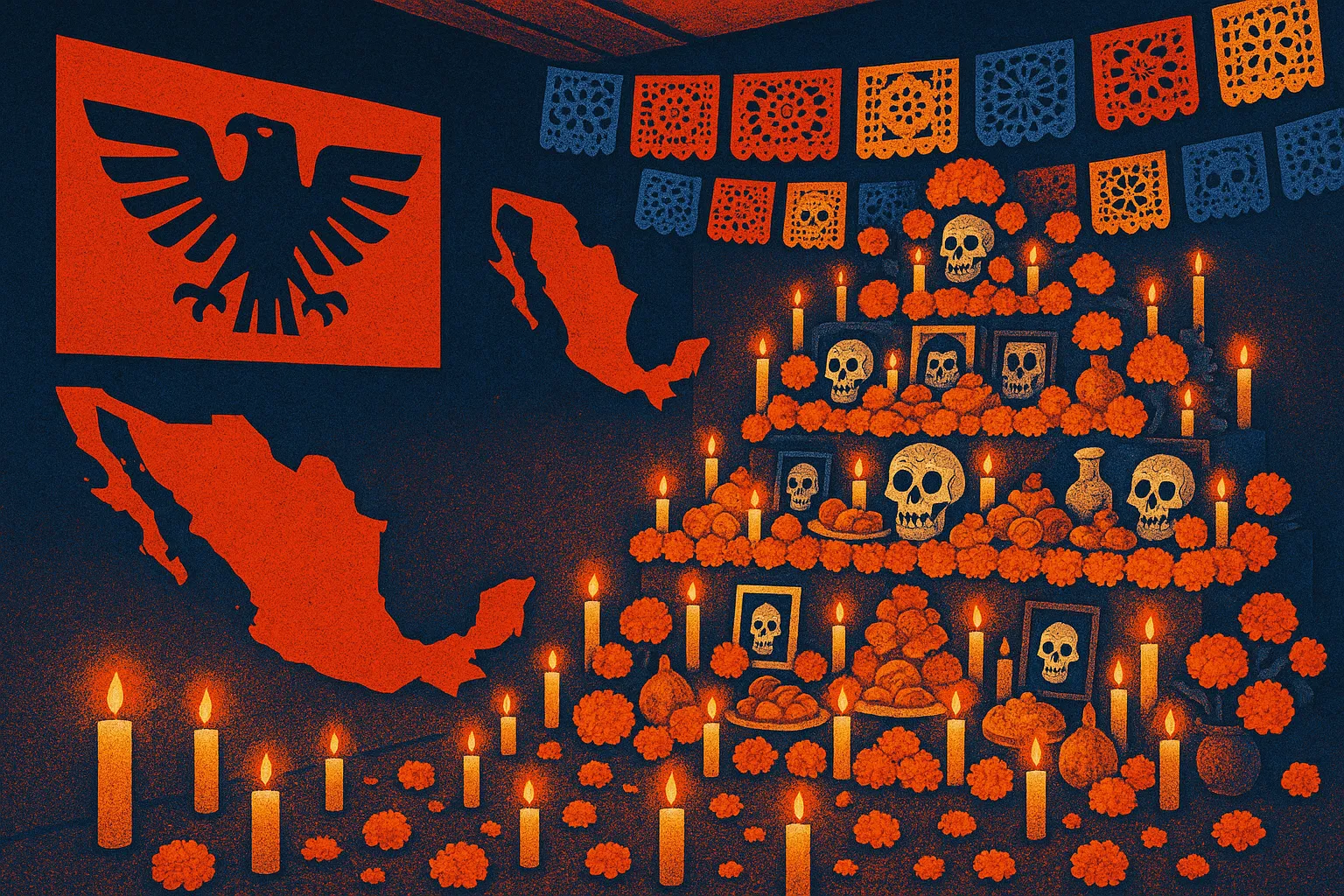
The exhibition of dozens of posters is expanded by a room-sized Day of the Dead altar with papel picado, candles, and bright orange marigolds (cempasúchil), surrounded by photographs of RCAF artists forming an ofrenda. Nearby, didactic photographs and objects explain the screen-printing process, alongside historic images documenting protests against the abuse of farmworkers and inequities of Chicano existence. Exiting the RCAF space, visitors encounter works by Los Angeles’s Carlos Almaraz and San Francisco’s Carmen Lomas Garza—artists who followed RCAF’s movement honoring Chicano art, history, and identity.
Rebels with La Causa: Royal Chicano Air Force Art and Activism, 1970–1990 is presented at the Crocker Art Museum, 216 O Street, Sacramento, CA 95814, February 22–June 28, 2026 (crockerart.org).
Vía artandcakela.com