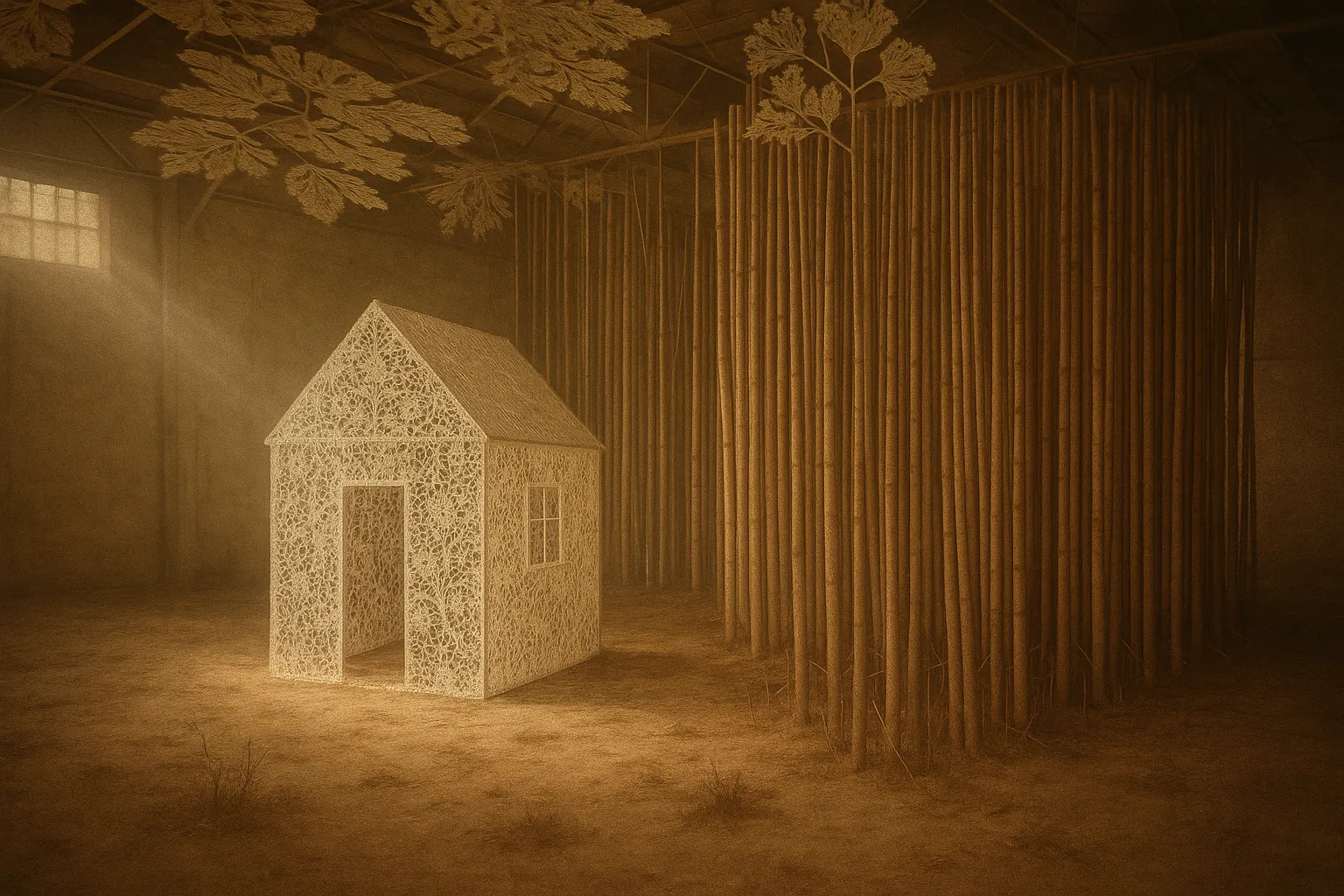
At the Arsenale di Venezia, the India Pavilion’s exhibition “Geographies of Distance: remembering home” unfolds like a lived-in memory. Curated by Amin Jaffer and on view May 9–Nov 22, 2026, the presentation inhabits the vast Isolotto warehouse with a setting conceived as a surreal private dwelling—its faint floor plan traced amid a panorama of a nearby town, towering bamboo, dry soil, and bulbous flowering forms.
Materials of remembrance
Near the entrance, Sumakshi Singh’s Permanent Address (2026) comes into focus as a monumental, lace-like reconstruction of the New Delhi home her grandparents moved into as refugees after the 1947 partition of India. Singh recalls “33 Link Road,” a site of births and marriages, and channels afternoons spent knitting and embroidering with her grandmother into a threaded homage where the architecture of memory is rendered as a delicate, almost spectral dwelling.
If Singh’s house seems to dematerialize into fiber, Asim Waqif’s Chaal (2026) asserts itself with dense, surging bamboos that thrust upward and sideways. Drawing on the visual grammar of scaffolding that blankets cities across India—construction ever in a state of becoming—Waqif’s rugged lattice feels as if it could outlast the hands that raised it.
Elsewhere, Alwar Balasubramaniam’s Not Just for Us (2026) shifts the tone. Sculptural panels formed from clay and soil sourced from rural Tamil Nadu bear evaporation cracks that register time and ecological fragility. Rather than sink into nostalgia, the work frames the water cycle as a recurring ritual of belonging and renewal, attentive to the land’s resilience through seasonal change.
Against one wall, Skarma Sonam Tashi’s Echoes of Home (2026) evokes a mountain settlement through clusters of earth-colored blocks made from papier-mâché of cardboard and discarded books, bound with tamarind seed glue and clay from Leh. Suggesting Ladakhi dwellings by outline and residue, the piece leans into flimsy, impermanent materiality—an analogue for a landscape and way of life in flux.
Overhead, Ranjani Shettar’s Under the same sky (2026) extends like a vegetal awning. Large, pale botanical forms, tinged with deep yellow, are entirely handwoven from cotton and steel, then lacquered. Their shadows gather across the floor with quiet abundance, distilling the gentler side of bittersweet memory.
Together, “Geographies of Distance: remembering home” does not simply elegize an address; it attends to the textures that persist—faint corridors mapped in the mind, the pulse of making and unmaking, the light that stays with you even when the walls have gone.