In 1961, Claes Oldenburg (1929-2022) penned his best-known text, “I Am For…,” a roughly 700-word statement for an exhibition catalogue. He later called it a “slightly satirical ode or paean to the possibilities of using anything in one’s surroundings (mostly urban) as a starting point for art.” Often labeled a manifesto, the artist maintained it was not. That restless openness to form and subject would underpin decades of sculpture that magnifies the everyday.
Oldenburg’s large-scale installations recast familiar tools and utensils at startling scale. “Spoonbridge and Cherry” (1988), made with Coosje van Bruggen, spans a pond at the Minneapolis Sculpture Garden. “Big Sweep” (2006) greets visitors at the entrance of the Denver Art Museum with a broom corralling crumpled paper into a dust pan. In Washington, D.C., the National Gallery of Art’s Sculpture Garden hosts “Typewriter Eraser, Scale X” (1998-99), whose rubber wheel seems to surge forward as its bristles stream in the wind. Rather than rely on found items, Oldenburg restudied and re-created forms from every angle, working with a team to fabricate works that remain recognizably ordinary yet newly strange.
Six Themes—then and now
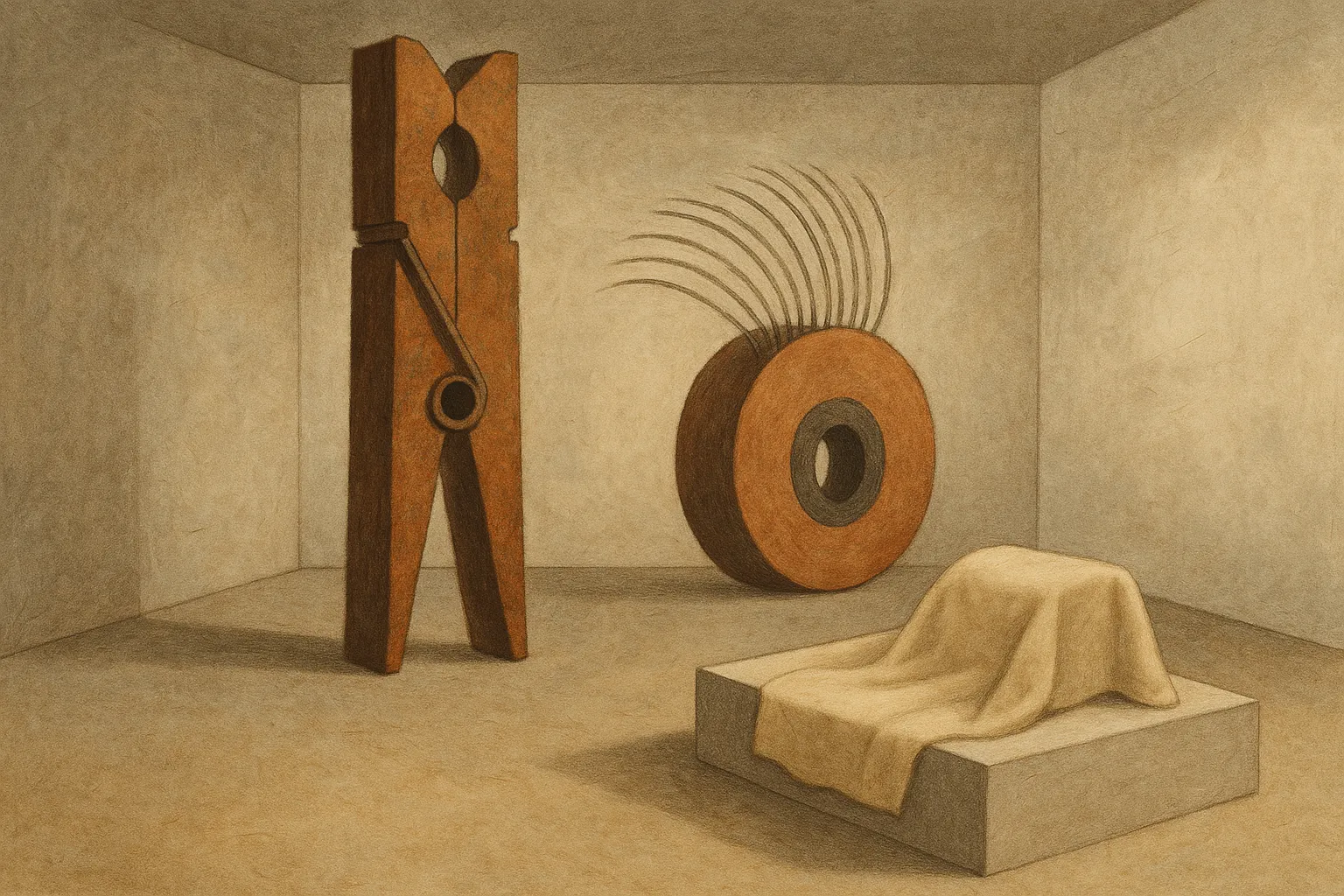
From the 1970s onward, Oldenburg delved into six recurring subjects—Geometric Mouse, Three-Way Plug, Fagends, Clothespin, Typewriter Eraser, and Standing Mitt with Ball—through sketches, models, and full-scale sculptures. He enlarged the clothespin until it read like a figure, and also pursued soft studies stitched in canvas, such as “1st Eraser Prototype” (1970), acrylic on sewn, stuffed canvas. “Fagend Study, Prototype” (1976) and “Geometric Mouse – Scale C” (1971) reflect the breadth of this inquiry across materials and scales. As he put it, “a requirement of any subject is that it be extremely adaptable, especially in scale, so that a small clothespin would be as interesting as a clothespin a hundred feet high.”
That adaptability is evident across realizations from a ten-foot “Clothespin” (1974) to the large-scale “Clothespin” (1976) in Cor-Ten steel and stainless steel at Center Square Plaza, Fifteenth and Market streets, Philadelphia. Over time, as tools like the typewriter eraser and the movie film projector—the profile of which informed Geometric Mouse—have slipped into obsolescence, Oldenburg’s motifs have taken on an unintended abstraction.
Back in New York
Several sculptures from the series go on view next month at Paula Cooper Gallery in Six Themes, a title that reprises the landmark survey mounted at the Walker Art Center in 1975 and later seen at the Denver Art Museum, Seattle Art Museum, New Orleans Museum of Art, and the Art Gallery of Ontario, Toronto. The new exhibition brings together significant works representing all six subjects, including rarely seen examples from the artist’s estate and private collections. On view in New York from November 5 through December 19, it reunites ideas that have not been presented together since their first showing 50 years ago. (An installation view of “Claes Oldenburg: Six Themes” was also documented at MIT Hayden Gallery, Cambridge, Massachusetts, in 1976.)
Half a century on, Oldenburg’s themes remain elastic, mischievous, and vividly of the world—exactly as his 1961 statement proposed.