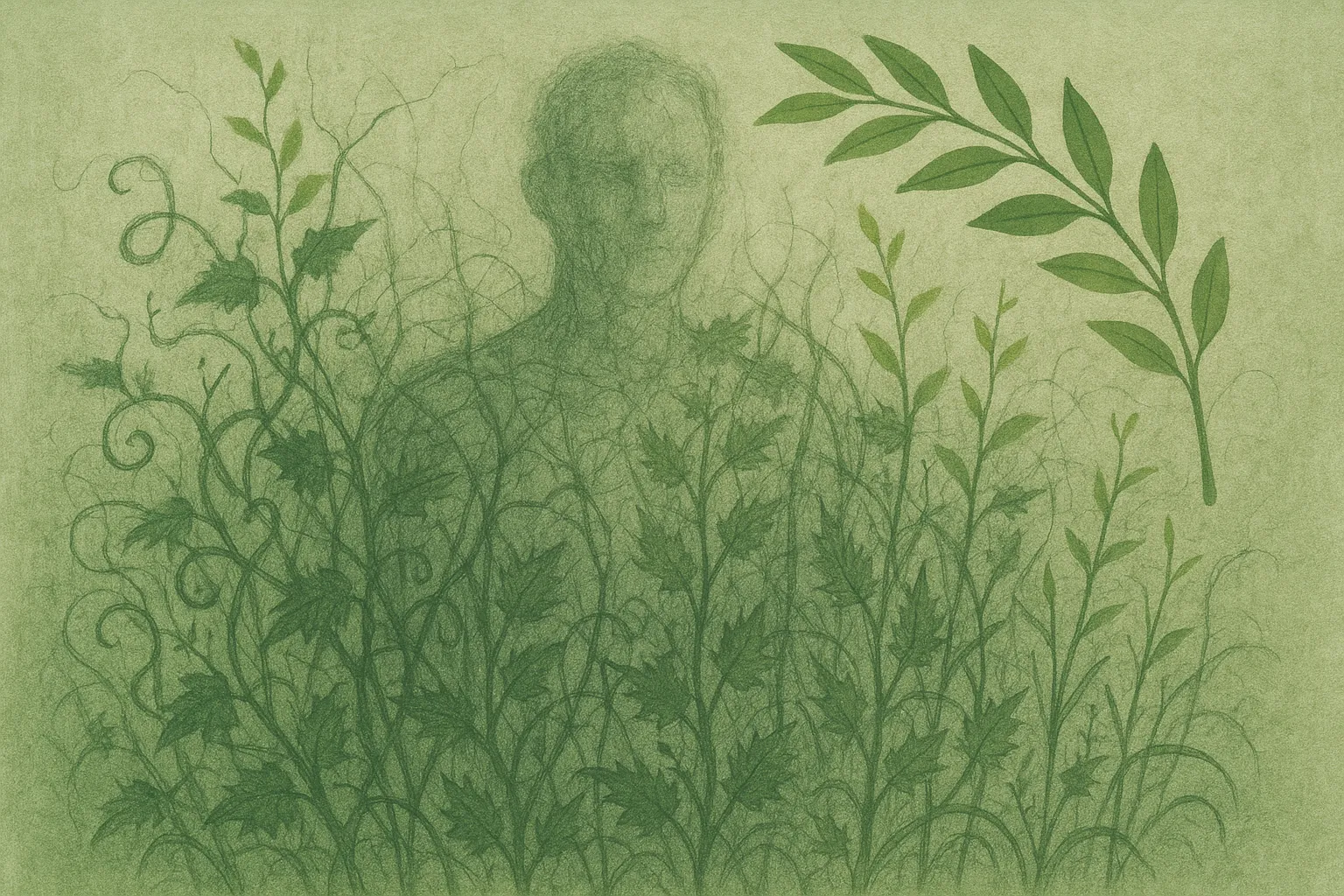
Devon-born, London-based artist Xanthe Burdett paints where bodies and botany meet. Working largely in a spectrum of greens, she layers leaves and vines over faint human silhouettes, collapsing the space between the figurative and the vegetal. Her paintings invoke mythology and ancient cosmologies to propose a kinship in which people and plants are, at times, one and the same.
Method, material, and a fertile overlay
Burdett begins with a sketch, then turns to the Renaissance-era cartoon method to move her drawing onto the surface—placing a substance like charcoal between the preparatory composition and the substrate before tracing the lines. From there, she methodically builds up foliage until the image reaches a lush density. As she puts it, superimposition becomes a way of “reimagining the body as a site of ecological and mythic transformation,” she says. “In an age defined by environmental catastrophe—wildfires, biodiversity loss, and climate anxiety—the work functions both as a refuge and as a space for imagining alternative ways of being with the more-than-human world.”
Her figures are presented as both “host and terrain,” carrying an undercurrent of renewal as “flesh gives way to nettles, brambles, and tender green shoots,” she adds. Many canvases look to deities, including Venus, the Roman god of beauty and fertility, and Janus, the god of transitions and beginnings.
Mythic echoes and recent works
Recent titles map the breadth of Burdett’s interests across medium and scale:
- “Janus” (2026), oil on linen, 30 x 25 centimeters
- “They came upon a clearing” (2026), oil on linen, 70 x 100 centimeters
- “Vegetable Venus” (2026), oil on linen, 80 x 160 centimeters
- “Viriditas” (2024), oil on Khadi handmade rag paper, 30 x 21.5 centimeters
- “Death of a Muse” (2025), oil on linen, 24 x 60 inches
- “The conversation” (2026), oil and metal leaf on board, 17.8 x 12.7 centimeters
This fall, the artist will be in residence at Soho Revue, developing a collection that explores the Greek tale of Daphne—who morphed into a laurel tree—as a way to conceptualize transformation amid climate catastrophe. The project extends her ongoing interest in entwining human form and plant life through a richly green palette and layered imagery.
For those following along, updates on the new series will be shared on Instagram.