Across centuries, cats have carried layers of meaning—from Bastet in ancient Egypt to the beckoning maneki-neko in Japan, and the lingering superstition of a black cat crossing one’s path. Artist Minyoung Kim zeroes in on that cultural tangle, centering black felines in paintings that balance poise with mischief. Her captivation, she says, comes from “the contrast between how ordinary and how weird they are.”
Mischief in the details
Kim builds an initial sheen of order only to seed it with slippages. “I want the painting to look visually inviting or polished at first glance, but as you stand there, you start noticing things that don’t quite add up—a reflection that’s wrong, an odd shape, an absurd gesture. That tiny moment of ‘Wait, what?’ is where the magic happens for me.” The black cat, loaded with what she calls “heavy cultural baggage,” has evolved in her practice “from a subject” into “a tool: sometimes a good luck charm, sometimes just a way to inject a bit of humour or subtle weirdness into a scene.”
Rarely passive, her creatures seem to plot around cutlery or stir up quiet chaos: sometimes only a paw or tail flashes into view, claws mid-swipe at a tablecloth or reaching toward a knife. “Just dropping a random paw, a single eye, or a curved tail into an otherwise mundane setup completely shifts the mood,” Kim says. “It interrupts the room…Ultimately, it’s about making the familiar feel just a little off.”
- Love Hurts (2023), oil on canvas, 120 x 90 centimeters
- Cat Sock (2024), oil on canvas, 100 x 100 centimeters
- Dark Thought (2024), oil on canvas, 150 x 130 centimeters
- Reflector (2024), oil on canvas, 90 x 80 centimeters
- Stolen Flower (2023), acrylic on unstretched canvas, 50 x 50 centimeters
Shifting symbols and sly illusions
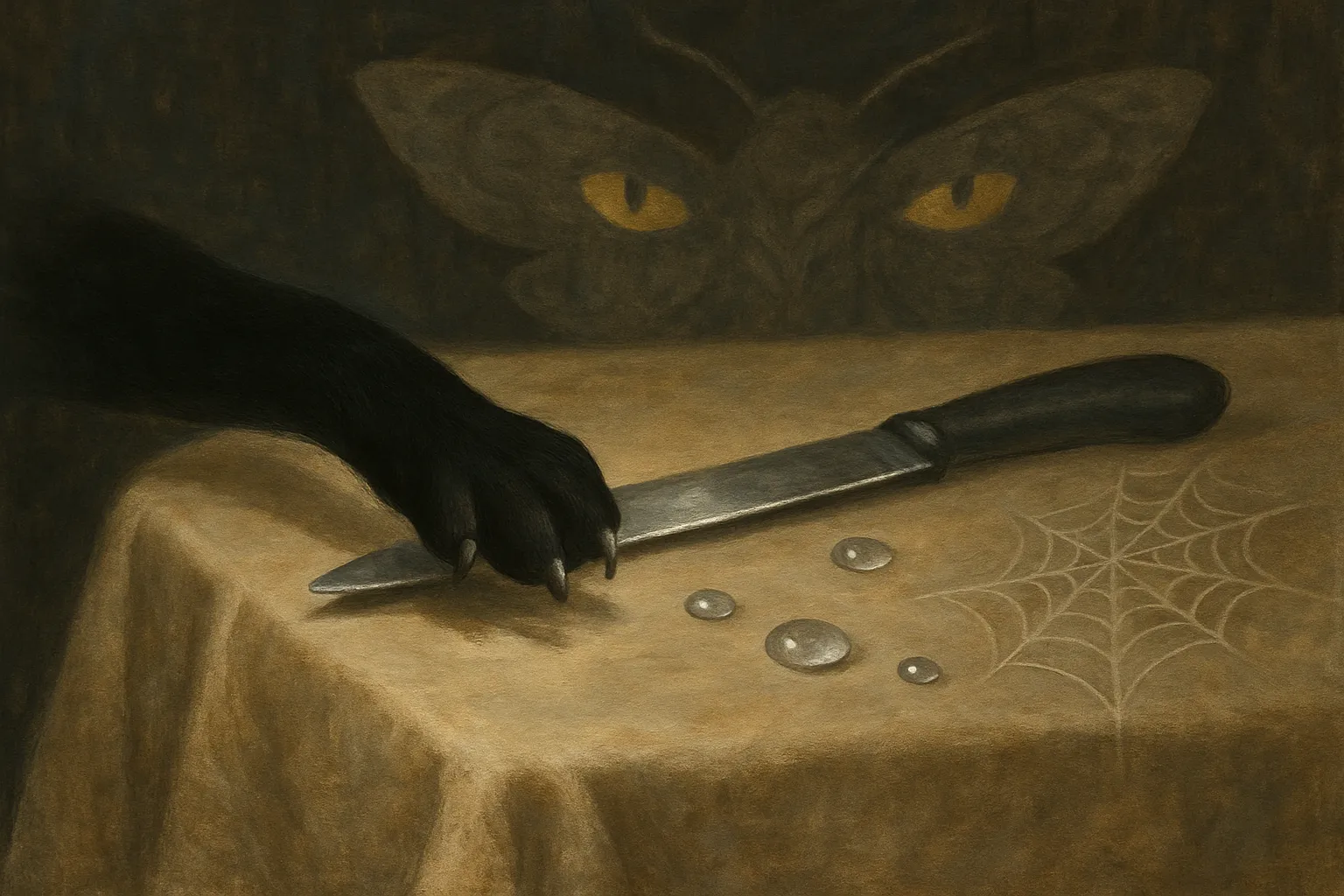
Kim toys with realism and absurdity, at times planting feline faces on tiny, fuzzy balls or critters, as in Cocktail Party (2024) and Chopped Melon (2024). In newer works, the cat can dissolve into signs: in The Shining Net (2026), oil on linen, 25.5 x 20.3 centimeters, the pattern of a moth’s wings alludes to yellow eyes while water droplets and an intricate web take center stage. She has been looking closely at European still-life painting, “specifically how it handles light, liquids, reflections, and moments of visual illusion.”
That sense of levity underpins everything. “Humour is huge for me,” Kim says. “Even though my paintings are pretty tightly constructed and technically meticulous, I really don’t want them to feel stiff or overly academic. I want them to have a sense of play.” Kim is currently preparing for a solo booth at Untitled Art, Miami Beach, where she’ll exhibit with Enari Gallery.