In Bilbao’s Basque Country capital, a major expansion of the Museo de Bellas Artes opens to the public on 6 October 2026: a floating pavilion conceived by Norman Foster’s Foster + Partners in collaboration with Basque architect Luis Mareda Uriarte. The 845m project doubles the museum’s exhibition area to around 6,000 sq. m and remodels a further 8,000 sq. m of existing galleries, reshaping the institution’s circulation and presence within the city.
Linking eras with a light-filled lift
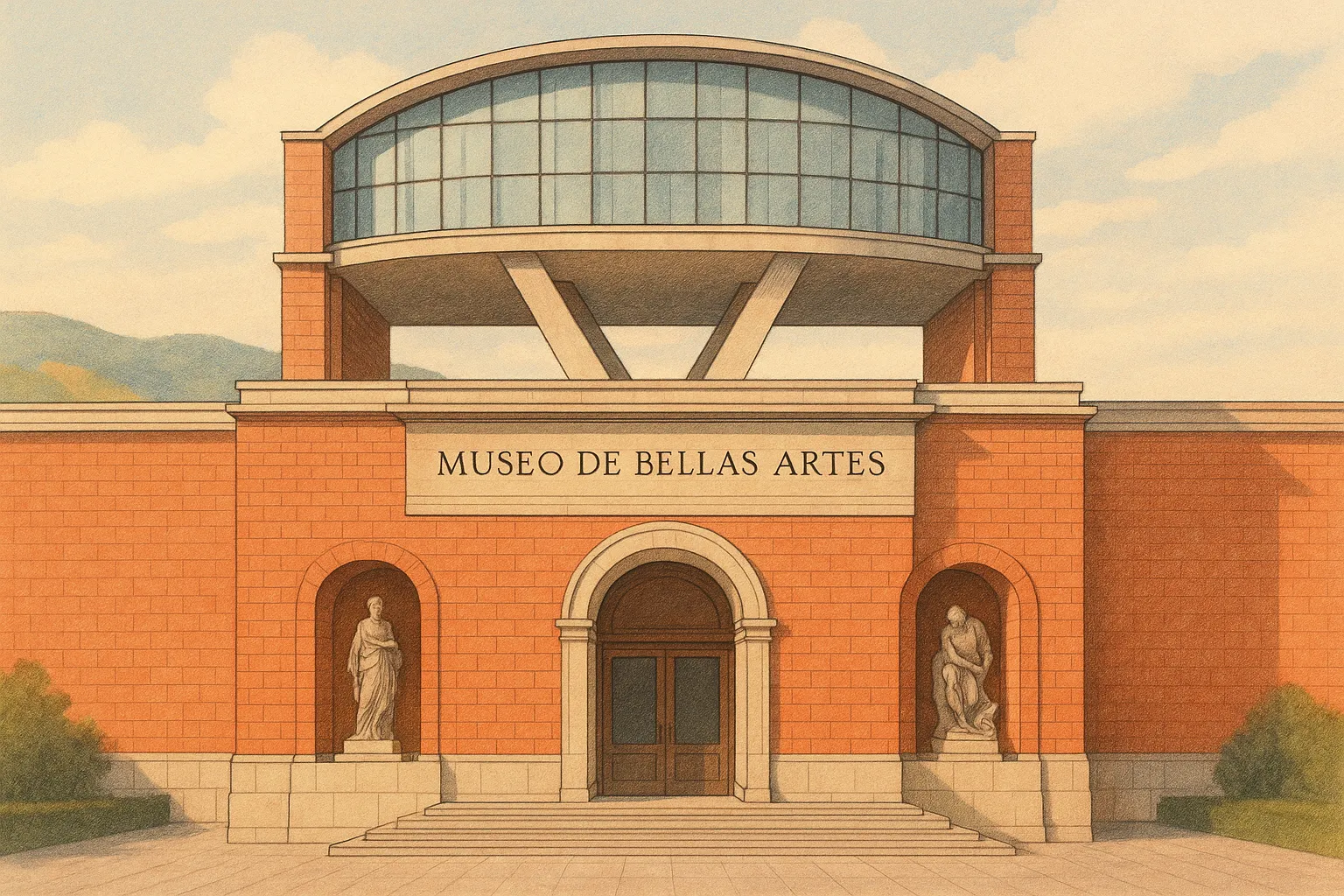
Until now, the museum’s holdings—spanning Lucas Cranach the Elder, El Greco, Zurbare1n, Goya, Mary Cassatt, Gauguin, Bacon and Richard Serra, alongside oriental art, archaeological treasures and decorative and applied arts—were split across two buildings: a Neo-Classical structure from 1945 and a Modernist, Mies van der Rohe-influenced 1970 expansion. Both were renovated in 2001 by Uriarte. The new extension links these wings and adds two curved, light-flooded upper storeys that overhang the front fae7ade, supported by giant V-shaped elements.
A 1,000 sq. m, light-drenched atrium now serves as a visitor centre and the nexus between old and new galleries. The red brick 1945 entrance—a classical rectangular archway flanked by twin statue-filled arched alcoves—will be restored and reinstated. The uppermost floor will host temporary exhibitions and includes a viewing terrace and a restaurant with views of the city and surrounding hills; there will also be a space dedicated to architecture and design, a new documentation and research centre, and offices, services and facilities. Additional spaces support the permanent collection—presented both chronologically and thematically—alongside the ongoing programme of temporary exhibitions, a new educational centre, and areas for family activities and workshops. On the upper level, a restaurant overlooks the park.
Reorienting the museum within Bilbao
The extension was selected via an open competition, in part for its sensitivity to the museum’s fabric. What appealed to us about the Foster and Uriarte proposal was that it didn’t interfere with the existing architecture, says Miguel Zugaza, the museum’s director. It enhanced it and offered a new dimension to the museum, integrating the two earlier styles of architecture—the 1945 building and the 1970 building—and uniting them in a very ingenious manner. It also fulfilled several different requirements: not only the physical expansion of the museum but also reorienting the museum towards a different side of the city—not towards the river but towards the Guggenheim [museum].
Less than ten minutes’ walk from the Guggenheim Bilbao and the Nervif3n River, the Fine Arts Museum gains clearer urban links as Foster + Partners have pedestrianised the centre of the roundabout in front and reduced traffic lanes. The great good fortune of a city like Bilbao is that we have two museums so close to each other, Zugaza says. We’re only 500 metres from the Guggenheim but we’re not in competition with each other. We have very different offers and different histories. The Fine Arts Museum can be seen as effectively the Basque Country’s national gallery and I think this new stage in our history will extend what we can offer visitors, not only to Bilbao but to the whole of the Basque Country.
The project is funded by the Basque government, the regional government, the provincial council and Bilbao city council in conjunction with the privately-owned BBK Banking Foundation.