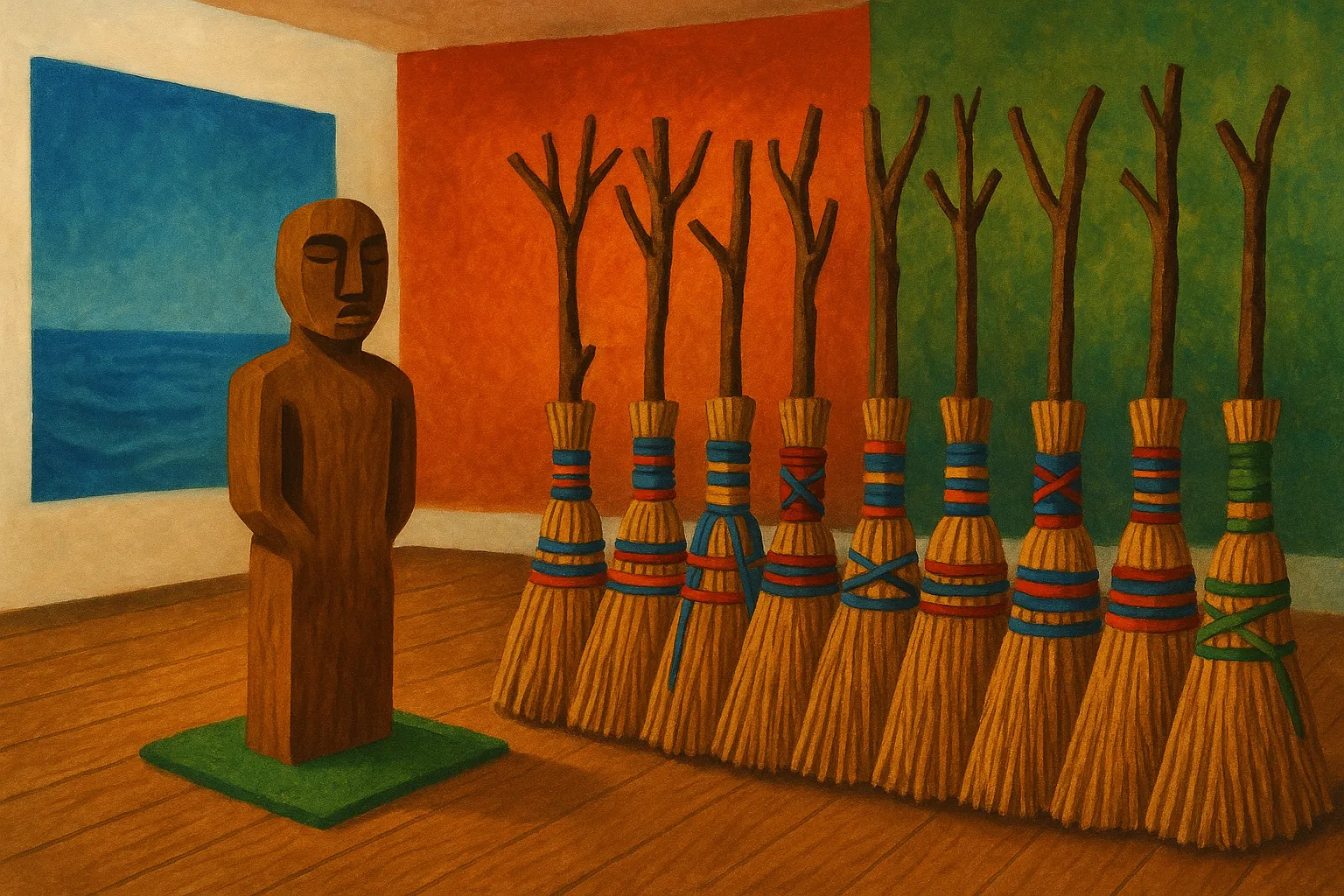
Step into the group exhibition Thresholds at the Haggerty Museum of Art and the first sight is a chorus of humble tools transformed: dozens of hand brooms arranged in long, orderly rows. Bound with scraps of ribbons, cords, and braids in a wide range of colors and textures, each sweeper sprouts raw branches from a fallen tree. Made during a participatory workshop in July at Lynden Sculpture Garden, the brooms are what artist Daniel Minter calls a “talisman, tool, and object of remembrance.” His ongoing inquiry into the broom reflects a broader practice that considers how cleansing and care—of space and self—can be acts of devotion and empowerment.
Assemblage as Vessel
At the Haggerty, Minter’s multi-faceted approach comes into focus. Alongside the community-created brooms, he presents vibrant carved sculptures painted with stylized portraits and superimposed motifs. These figurative assemblages merge found objects with carefully selected materials that, as the artist sees it, become vessels for spiritual and ancestral knowledge. In a catalog essay for Thresholds—which pairs the museum’s holdings with his sculptures—Minter writes, “I came from a people with a long and complex tradition of creating exactly these kinds of tools—objects of communication and transformation. The objects and masks from the Haggerty Museum collection bring my work into direct contact with that timeless technology. They allow me to see my carving as a way of reconnecting with and continuing a living system of communication with the spirits, the ancestors, the unseen.”
Nature, Color, and a Public Offering
Minter is intentional about staging spaces for such communion. Nature is the foundation, and the walls in his section of the exhibition are keyed to its facets: blue for the ocean, red for fire and thunder, and green for the forest. A central, freestanding sculpture positions an abstract, totemic figure on a patch of astroturf—typically presented outdoors or in a forest—and serves, in his words, as an instrument of hope. “How do you find the things you need to see a future when the objects before you say different?” he asks. “Do objects transmit spirituality? No, they remind us of our spirituality. They allow us to translate. A particular object can remind you that you can think deeply and pass this obstacle that is in front of you… That’s a service.”
Based in Portland, Maine, for more than two decades, Minter was raised in Georgia during Jim Crow, across the street from a white-only swimming pool; his schools were segregated until fourth grade. “When you start seeing the systems that create these inequalities, you also can begin to notice systems that empower you,” he says. “You notice the systems that give you a stronger sense of yourself.” That sense was nurtured by his mother’s constant singing and his own drive to make: as an adolescent, he carved small sticks and painted signs for neighbors, later studying illustration in college. He still collaborates on children’s books, and his work for Going Down Home with Daddy even won the prestigious Caldecott Medal.
Thresholds is on view through December 19 at the Haggerty, which is part of Milwaukee’s Marquette University.