In his Beijing studio, SHI GUOWEI speaks about festivals without spectacle. His new body of work, debuting at Fotografiska Shenzhen this October, looks past pageantry to the traces left behind. An installation view from 2026 captions the presentation as “Shi Guowei: Festa,” signaling the focus that now preoccupies him: what remains when the crowd thins, the music fades, and time resumes its quiet accounting.
Drum and Bridge
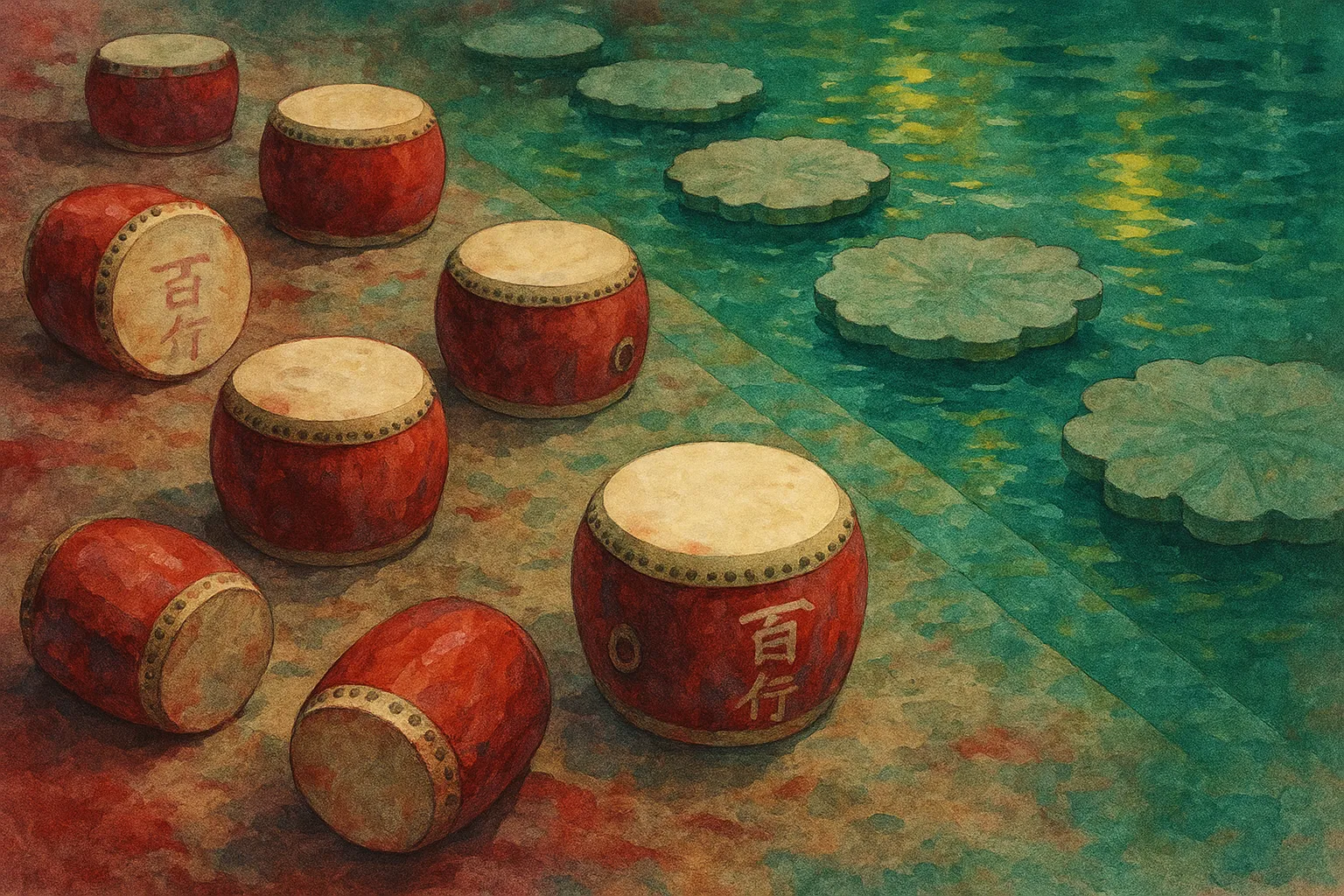
On the wall hangs Drum (2026), a large tableau of red ceremonial drums arrayed on a grubby floor beneath a nondescript pillar. The tilted vantage feels casual, yet the instruments hum with a residual charge. “They were perhaps being played just moments ago,” says Shi, “then cast aside while people moved on to other festivities.” The maroon lacquer is mottled; the gilding has dulled; the faces are stark white, the characters 百年行 (“a hundred-year journey”) discernible on top. Across the studio, a smaller square study of rock echoes the same plum-toned burgundy—an afterimage linking his long-standing attention to stone and shrub with this turn toward human celebration’s residue.
Nearby, Bridge (2026) turns the palette green. Round, scalloped cement pavers—cast to resemble lotus leaves—seem to float on a pond. Algae lends a jade cast; the water glimmers deep turquoise; brilliant chartreuse wavelets breach the calm from the upper left. The disturbance, he notes, came from artificial light reflected from festivities just outside the frame. “It was a tremendously crowded day,” he recounts. “I had to wait hours to capture this view without people.” The intrusion of yellow is intentional: “On an ordinary day, the water would simply mirror a blue sky. But here there is something invasive. A quiet space has been forcibly entered. I wanted to convey that uneasy contrast.”
Hand-coloring as duration
Shi’s method begins with a black-and-white photograph, which he paints over with water-based pigment in exacting layers, an approach he calls an “authentic illusion.” Trained at Tsinghua University’s Academy of Arts & Design and later at the Fachhochschule Dortmund, he revives the largely obsolete technique of hand-coloring not toward mere verisimilitude but toward what he terms “felt truth.” The patience shows: over months, a single exposure is revisited until color seems to loosen the image from the instant of the shutter. As he puts it, “some things require time.”
“For some time I have found myself drawn to festivals,” Shi says, “but not their pageantry. What holds me is a quality I encounter around them, or after them.” That sensibility threads through titles across recent years, from Fireworks II (2025) to Garden II (2024), and into works-in-progress: a flamingo boat half veiled by riverside shrubs; a couple on a canopied boat glimpsed through trees, part colored and part grayscale. “Festivals are understood as collective occasions of happiness and hope,” he adds. “But I am interested in what an individual experiences. Private feelings can diverge greatly from the noise and commotion. I want to ask what joy actually is.”
Shi Guowei: Festa, Fotografiska Shenzhen, 2026. Courtesy the artist, Magician Space, Beijing, and Fotografiska Shenzhen.