Mexican photographer Graciela Iturbide has built a formidable body of work by immersing herself in the communities she photographs. Her images, made largely in Mexico, attend closely to the specificity of people, places, and rituals, revealing layered connections across the country’s cultures and geographies.
Living among subjects, shaping an image
Where critics such as Susan Sontag once called the camera “a predatory weapon,” and even pointed to Étienne-Jules Marey’s 1882 “chronophotographic gun,” Iturbide counters with time, presence, and consent. She has lived and worked for extended periods with the Seri Indians of the Sonoran Desert and the Zapotecs of Oaxaca, and has also photographed the urban poor of Mexico City and Chicanex gangs of eastern Los Angeles. The approach is intimate and sustained, rooted in daily life before a camera appears.
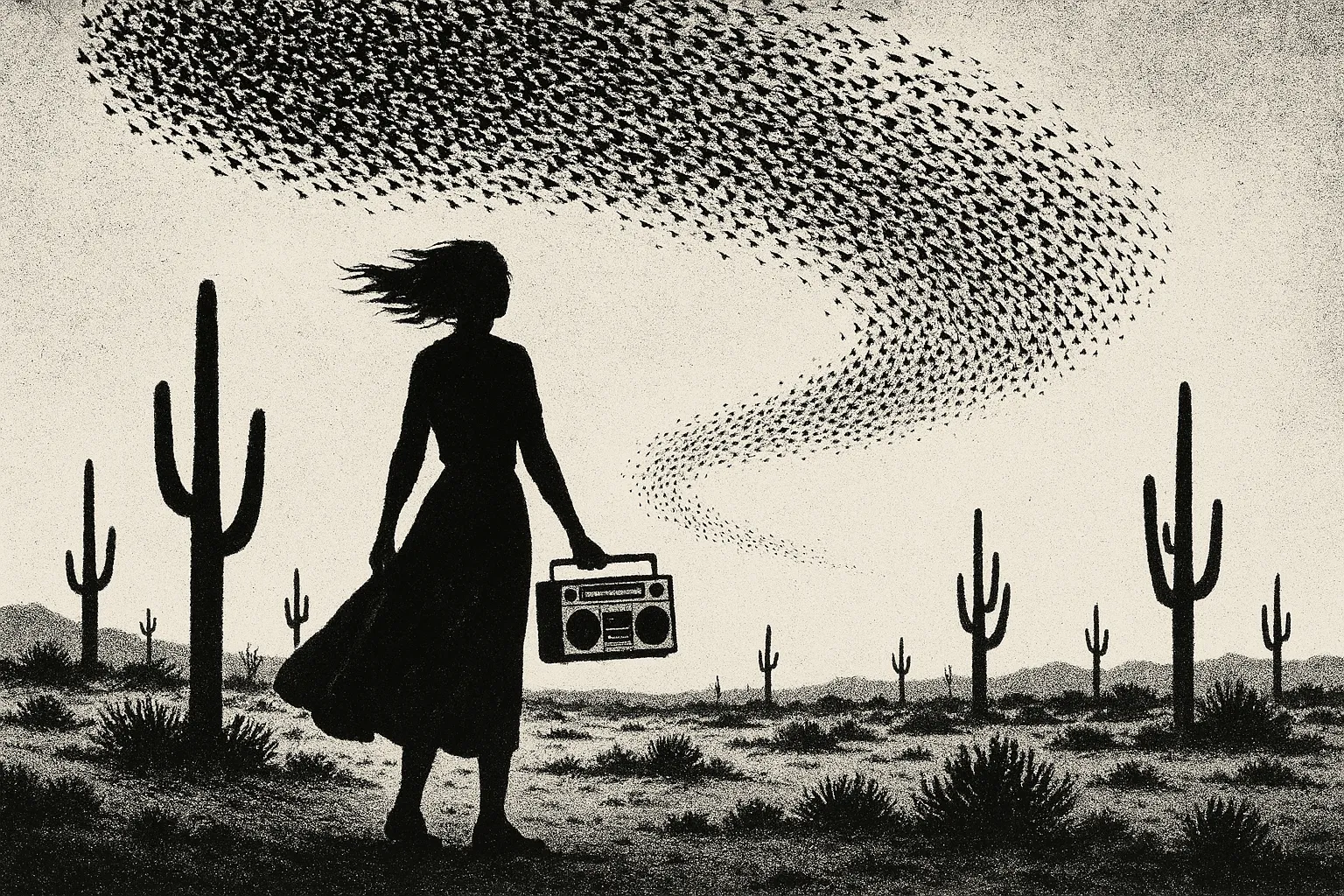
Her pictures have become touchstones. In Mujer Ángel, Desierto de Sonora (Angel Woman, Sonoran Desert), 1979, a long-haired Seri woman moves through the desert in a long white skirt and dark fitted jacket, carrying a modern boom box acquired from a US tourist—a concise sign of mass media reaching even remote communities. Also from 1979, Nuestra Señora de las Iguanas shows a Zapotec market woman balancing five iguanas on her head, transforming a customary way of carrying goods into a startling headdress. The cultures of the Isthmus of Tehuantepec in Oaxaca are known for matriarchal traditions; Frida Kahlo drew inspiration there, adopting long skirts and embroidered huipiles (short, square blouses made on a backstrap loom).
Iturbide studied with Manuel Álvarez Bravo in Mexico City, where she continues to live, and her framing often isolates figures against walls or windows in poised stillness. Two photographs from 1986 portray a transvestite male named Magnolia: in one, a long, flowered dress and a small square mirror; in the other, a big round sombrero, beaded necklace, and the hem of a short sleeveless dress held out. Among the Zapotec, individuals born male who adopt female clothing and behavior are called muxe and are considered a blessing, a third sex.
In 1991, in Coyoacán, Iturbide made the self-portrait Ojos para volar? (Eyes to Fly?), holding two birds to her eyes—one alive, one dead. She has photographed birds in many forms, from skies filled with murmurations to leafless treetops and shadowy stick puppets. Rejecting “fast labels for Latin American art,” she insists she captures “what was naturally there in the moment,” using black-and-white almost exclusively to “stay true to the dignity of her subjects.”
At SFMOMA: a five-decade view
Graciela Iturbide: Between Two Worlds, a major retrospective spanning more than five decades, was on view at the San Francisco Museum of Modern Art (SFMOMA) from July 11 through November 29, 2026. Featuring more than 150 photographs, the exhibition was organized by Fundación Mapfre in collaboration with SFMOMA (151 Third Street, San Francisco, CA 94103).
Vía artandcakela.com