Olivier Marty, co-founder of the Paris-based architecture firm Studio KO, has turned a 1912 tram depot and diesel station in the heart of Tashkent into the Centre for Contemporary Arts Tashkent (CCA Tashkent)—the country’s first permanent institution dedicated to contemporary art. Speaking to ArtAsiaPacific ahead of the public opening, he outlined an approach honed on cultural commissions including the Yves Saint Laurent Museum in Marrakech (2017) and the Musée de la Mode et du Costume in Arles (2025), projects noted for restraint, material intelligence, and a preference for subtlety over spectacle.
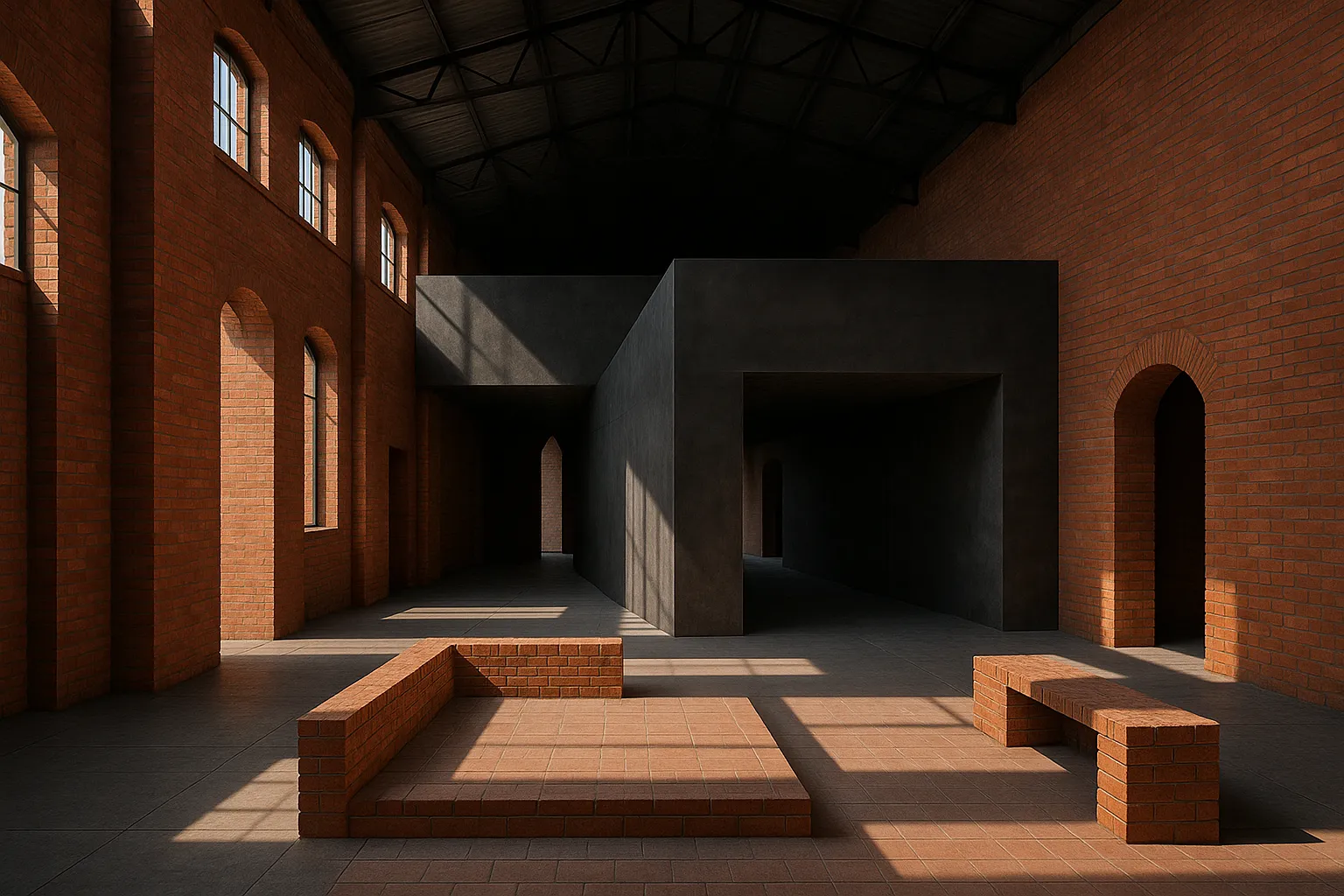
Working with partner Karl Fournier, Marty kept the building’s character front and center. The main exhibition hall retains original brick walls and vast proportions—“basilica-like”—while a dark metal tunnel guides visitors through to the galleries and new courtyards make measured nods to traditional Uzbek forms. “It takes time—the time to give attention and sincerity to each layer,” said Olivier Marty. Describing a careful audit of later accretions and a revival of long-disappeared techniques—“brick and joint treatment, zinc cladding on horizontal elements”—he noted that new insertions were rendered in deliberate contrast: “They are dark, with the feel of poured concrete, as opposed to the modular brickwork typical of imperial architecture.” The result is a contemplative, flexible environment calibrated for exhibitions, research, and public programs. The main hall has even been described as a smaller version of the Tate Modern’s Turbine Hall.
Material lineages and a pedagogical echo
Studio KO’s long engagement with Morocco carries over as method rather than style. “We like to say that the Studio’s response is more an approach, an attitude, rather than a style… listen and observe a lot before making choices,” Marty reflected, citing “the minerality of the country, the colors of the soil, the vernacular repetition of courtyards.” Research from the 2023 Uzbekistan Pavilion at the Venice Architecture Biennale, “Unbuild Together: Archaism vs. Modernity,” also resonated. Working with students and artisans around the mud-brick qalas of Karakalpakstan, Marty found “chronological porosity between archaism and modernity,” noting affinities with CCA Tashkent’s tunnel and massing, and hands-on experiments with terracotta brick “of both layouts and finishes, natural or glazed.” Before renovation, the team installed in the diesel station “a crazy one-to-one model of the Venice labyrinth,” an echo heightened by the space’s near match to the Arsenale in dimensions.
The new courtyard is conceived as a contemporary version of a traditional mahalla. “The enclosed space, big gate, perception of the surrounding construction and urban fabric—all of this is all the same, although the expression is different,” Marty said. On the broader civic brief, he added: “Scale-wise, even politically, there are many similarities, because the project serves a purpose combining altruism, power, and vision… for the first time it is not dedicated to couture or textile like in Arles, but to artists.” Early programming has already animated the halls, with installation views of works by NADIA KAABI-LINKE, NARI WARD, TARIK KISWANSON, and ALI CHERRI.
For Marty, accepting the industrial and imperial traces is foundational: “In this region there can be a path to modernity and development based on accepting the traces of the past.” The public response has been immediate: “5,650 visitors on the first day… Collective emotion.”