In an era defined by global interconnection, new technologies, and engineered systems, once-stable lines around culture and selfhood have grown porous. “Soft Borders,” on view at Blindspot Gallery in Hong Kong from Sep 15–Nov 7, 2026, convenes Igshaan Adams, Aiko Tezuka, Bi Rongrong, Kazuko Miyamoto, Angela Su, and Yee I-Lann to probe how identities are shaped and reshaped within shifting frameworks.
Unraveling Histories and Colonial Afterlives
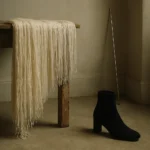
Aiko Tezuka opens the exhibition with Lessons for Restoration (2026), refashioning textiles that once pictured Western pastoral scenes. By pulling loose their threads to blur and interrupt focal imagery, she points to the entangled exchanges between Japan and European merchants from the 16th century onward, when imported aesthetics began to overshadow established Japanese techniques. As strands trail outward into space, the works literally push past their frames, urging viewers to consider how artistic languages mutate across time.
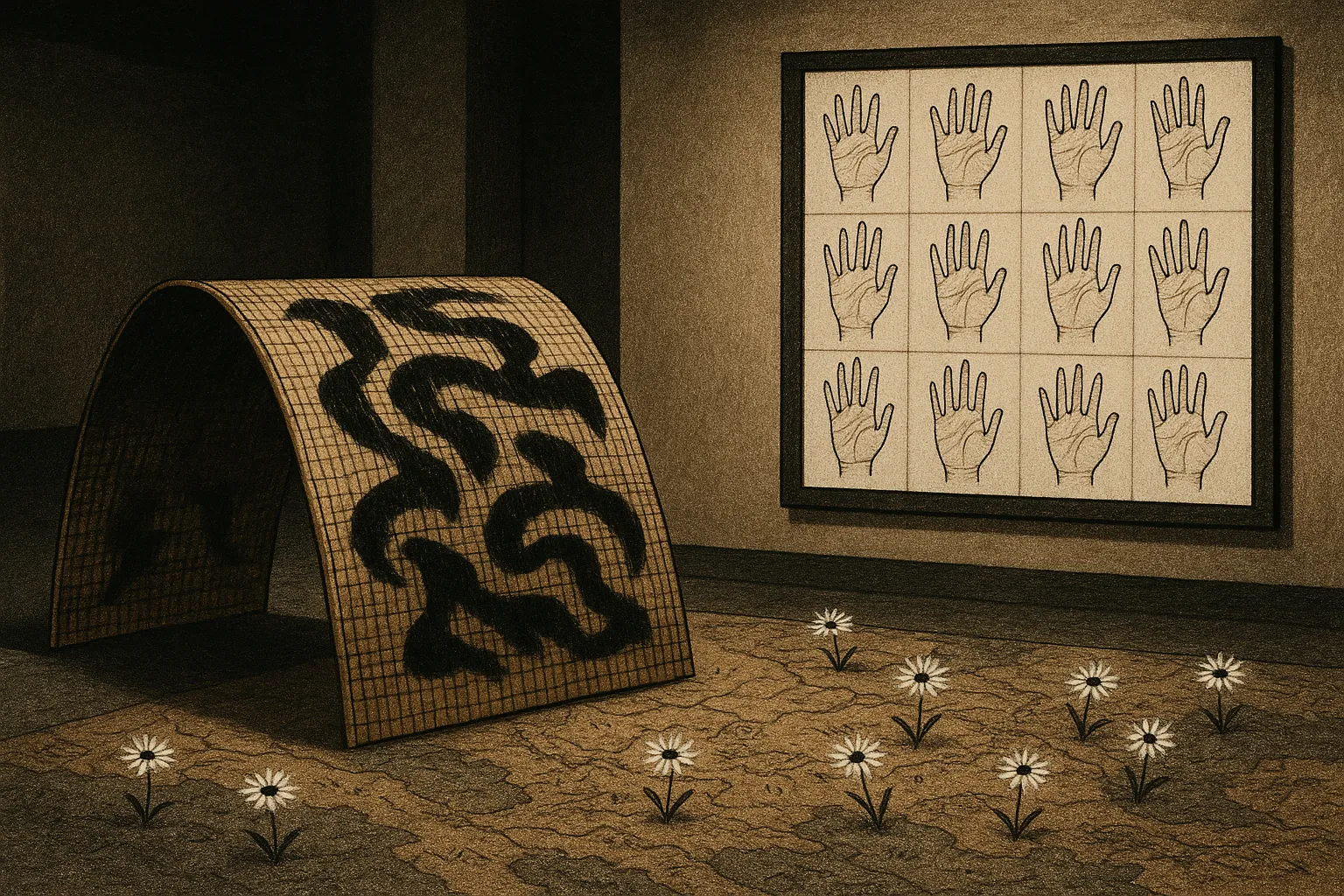
Nearby, Yee I-Lann examines Southeast Asia’s colonial imprint. Doormatic Glide Refractor (2024) is a mat woven from bamboo pus, overpainted with black-dyed patterns; two painted mats tilt upright, evoking a flipped table—an emblem of a heavy European object that, as the work proposes, supplanted the widespread use of light mats in Malaysia and Indonesia. In dialogue, A map of Mansau-ansau (2024) alters with the viewer’s angle, its pared-back surface echoing Yee’s larger claim: structures can be reoriented by a shift in perspective.
Counting with Bodies, Mapping with Hope
Installed in near-darkness, Angela Su’s The Fabric of Time (2026) marks the room with a metronomic tick. The installation gathers a clock built from stop-motion animation; a month-length array of hands stitched from human hair; and a separately framed, hair-worked closed fist—signifying zero (“null”) in one-handed finger binary. Each hand corresponds to values one through 31 in a mid-20th-century system devised as a biomechanical analog to computer code. As automation pervades daily life, Su’s painstaking hair embroideries—material of the body used to picture the body—probe how we understand our own anatomy alongside technology’s logics, while acknowledging that every organic and mechanical process winds down.
Igshaan Adams closes on a note of resilience. Nama stap (ii) (2026) — a tapestry of cotton and sisal twine, braided rope, and an array of beads, shells, lace, and ribbons — depicts a bird’s-eye mapping of movement across Namakwaland, the arid South African region annually transformed by a desert bloom. In light of a childhood under apartheid, the work considers enforced borders, yet counters them with the image of daisies that return each year: what seems fixed can yield; change persists; hope endures.
“Soft Borders” does not fix answers. Instead, it asks us to reconsider what we inherit, what we’re made of, and which viewpoints we choose to keep.