At Moody Center for the Arts at Rice University, Radiant Geometries: Vectors of Knowledge from the Indigenous Americas gathers artists across South, Central, and North America into a vivid, multi-media dialogue. Curated by Noor Alé and on view in Houston through December 19, the exhibition frames contemporary practices through Indigenous interpretations of mathematics, science, and architecture, drawing out cosmologies, narratives, and technologies that resonate across time.
The show’s throughline is clear from its historical touchstones: for centuries, Navajo/Diné weavers have produced intricate, geometrically patterned blankets and rugs on upright looms powered solely by the artisans’ bodies, while more than a millennia ago in Mesoamerica, Mayans created ornate ceramics animated by natural motifs such as birds. Using materials gathered or cultivated from the land—Diné communities have herded the distinctive Navajo-Churro sheep since the breed’s 16th-century introduction by Spaniards—these traditions continue to guide and inspire artists today. Paintings, sculpture, video, and sound works in the galleries probe mathematical, metaphysical, social, and environmental realms, aligning material knowledge with lived experience.
Artists, materials, and lineages
Melissa Cody begins with a foundation in Diné weaving, drawing on the teachings of three generations before her. Working between a vertical Navajo loom and a mechanized Jaquard machine, she fuses long-held motifs with contemporary patterning and messages. Her “Sunrise Rainbows” (2025) exemplifies this approach, a Jacquard weaving with aniline dyed wool fringe (70 x 40 inches), presented courtesy of the artist and Garth Greenan Gallery, New York.
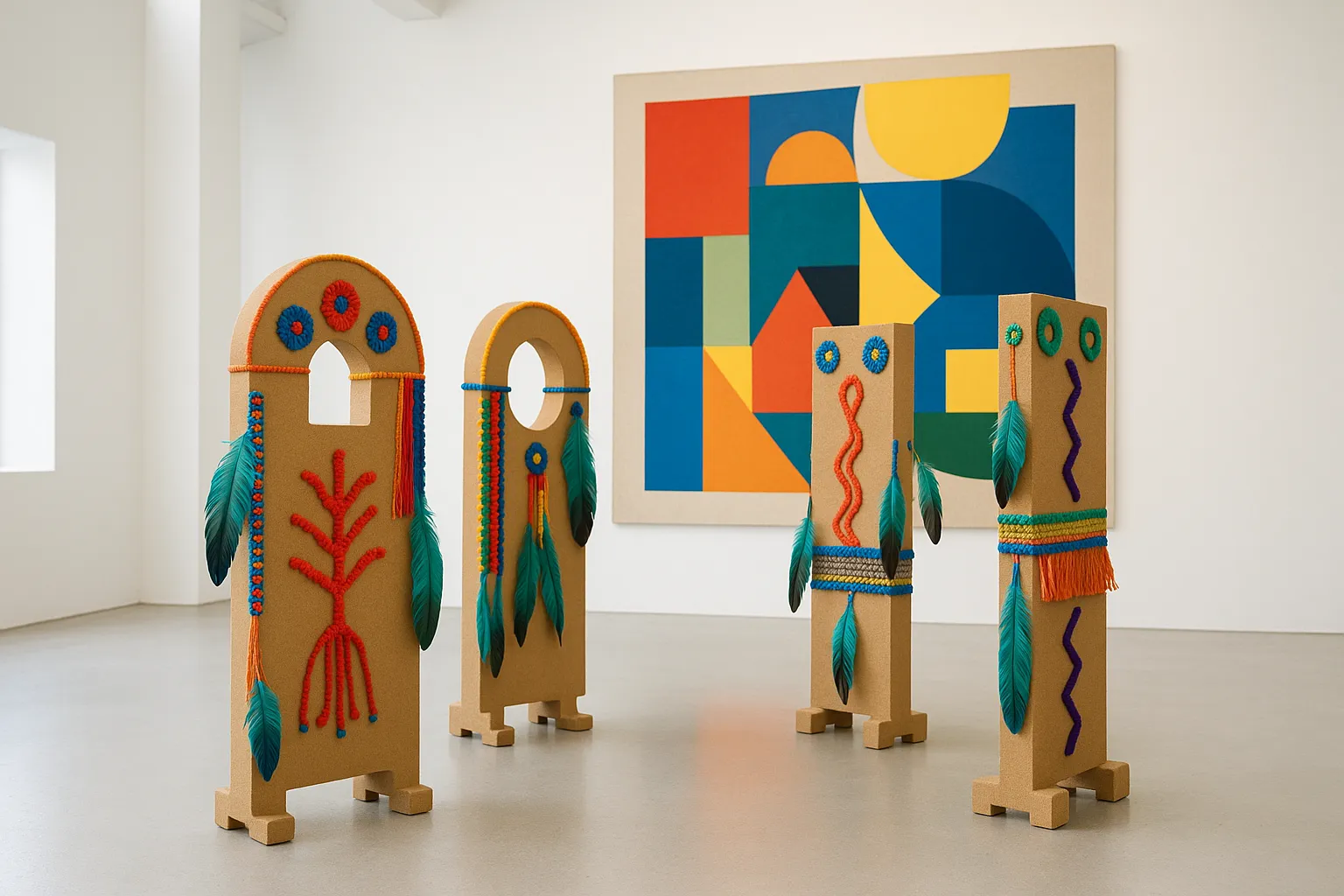
Eamon Ore-Giron’s large-scale geometric abstractions form a commanding presence, nodding to Indigenous motifs and symbols—from Native American medicine wheels to tapestries from the Amazon Basin—while engaging the 20th-century language of geometric abstraction, especially hard-edge painting. Among the works on view are “Black Medallion XIV (Inti)” (2022), mineral paint and Flashe on linen (198 x 258 inches), and “Talking Shit with Object 17 (Pre-Columbian ceramic plate with avian designs, 300-900 CE)” (2026), mineral paint and Flashe on linen (30 x 30 inches), both courtesy of the artist and NORR COHAN, New York.
Foregrounding Ore-Giron’s canvases, Natalia Montoya Lecaros’s Tótems de emergencia gathers four upright, mixed-media sculptures on “feet,” installed in a circle that evokes a ceremonial cadence. Drawing a figurative thread from the garments of the Aymara people of the Andes—renowned for vibrant, handcrafted clothing shaped by Indigenous traditions and Spanish influences—the modular MDF forms incorporate tempera paint, acrylic yarn, beads, lined cardboard, and bird feathers (courtesy of the artist and Judas Galería, Valparaíso).
Additional artists in Radiant Geometries include Patricia Domínguez, Jordan Ann Craig, Nanibah Chacon, and Patrick Martinez. Works by Caroline Monnet—such as “A Quiet Place” (2021), print on Enermax (46 x 46 inches)—and Nanibah Chacon—“Where Two Rivers Meet” (2026), mixed media, sound installation—extend the exhibition’s sonic and spatial reach. “At its core, Radiant Geometries centers Indigenous ways of knowing that continueto shape relationships to territories, waterways, and interspecies care,” Alé says.
The museum is also hosting a large-scale vinyl installation by Sharmistha Ray, which opens on October 22 and will remain on view through January 29.